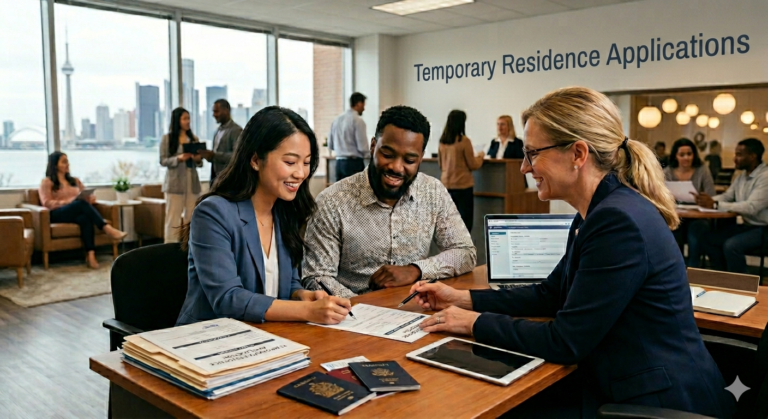
Temporary Residence Applications
Whether you want to visit, study, or work in Canada, we provide clear guidance and professional support.
Visitor visa
For individuals who want to visit Canada for tourism, family visits, or short stays.
Study Permit
For international students who wish to study at designated learning institutions in Canada.

Work Permit
Authorization to work in Canada, including both employer-specific and open work permits.

Super Visa
For parents and grandparents of Canadian citizens or permanent residents to visit Canada for extended periods..
Temporary Residence in Canada—Visas, Study & Work Permits

Visitor Visa
A visitor visa allows you to travel to Canada for tourism, family visits, or short-term stays.
We help you:
- Prepare a complete and strong application
- Demonstrate ties to your home country
- Address previous refusals, if applicable
Study Permit
A study permit is required for international students who wish to study at a designated learning institution in Canada.
Our services include:
- Applying for Offer letter and PAL
- Reviewing your Letter of Acceptance (LOA)
- Preparing a strong Statement of Purpose (SOP)
- Ensuring proper financial documentation
- Identifying and addressing potential concerns
Work Permit
A work permit allows foreign nationals to work legally in Canada for a specific period.
We assist with:
- Employer-specific work permits
- LMIA-based and LMIA-exempt applications
- Post-Graduation Work Permit (PGWP)
- Spousal Open Work Permit
- International Experience Class
- Refugee Claimant/Temporary Resident Permit Holders
- Work permit extensions
Spousal Open Work Permits (SOWP)
Spouses or common-law partners of eligible workers or students may qualify for an open work permit.
The rules for spouses changed significantly in 2026. We help you navigate the new restrictions to determine if you qualify based on the primary applicant’s program:
Assessing eligibility for spouses of master’s (16+ months) and PhD students.
Securing permits for spouses of skilled workers in TEER 0, 1, 2, or 3 occupations.
Explaining the new limitations for spouses of undergraduate and college students.
Post-Graduation Work Permits (PGWP)
The post-graduation work permit (PGWP) allows students who have graduated from eligible designated learning institutions (DLIs) to gain valuable Canadian work experience. A degree no longer guarantees a work permit.
We ensure your path to PR is protected by:
verifying your Field of Study against the 2026 eligible CIP codes (Healthcare, STEM, Trades, etc.).
Assisting with the mandatory Language Proficiency (CLB) requirements now required for all PGWP applicants.
Strategic planning for Master’s graduates to secure the 3-year permit regardless of program length.